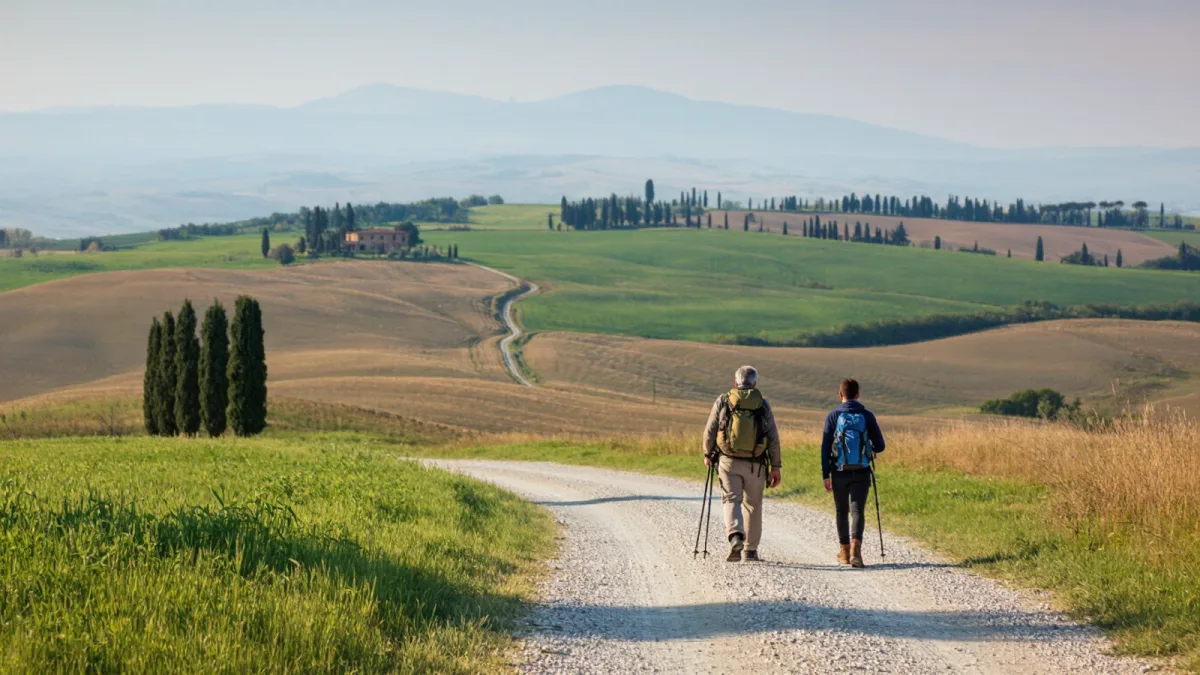
Walkers from 58 countries earned Via Francigena credentials in 2025, per the route's official coordinating body, the European Association of the Vie Francigene — a headcount small next to the Camino's, but markedly more international than the route's Italian base ever used to be. The association's 2025 summary, published after the walking year closed, describes a pilgrim flow spread across the route's full length from Canterbury to Rome rather than concentrated in the final approach.
The Francigena has spent two decades being rebuilt out of fragments: Sigeric's tenth-century itinerary from Canterbury to Rome, reconstructed in 1994 and signposted ever since. Growth remains modest by design of geography — the route crosses the Alps, the Po plain and four Italian regions where accommodation is thinner than in Tuscany — and this site reports such data for what it signals about the villages the path threads through, not as an invitation to book.
What changed on the route for 2025 and 2026?
Per the association's updates, work concentrated on the Italian sections: improved path surfaces and safety measures, new and standardized signage, and expanded pilgrim accommodation, with municipalities along the Lucca–Rome corridor — the most walked stretch, roughly 430 kilometres through Tuscany and Lazio — investing in water points and rest areas. The upgrades anticipate heavier traffic around the Catholic Jubilee cycle centred on Rome.
Related stories: Half a million pilgrims: the Camino de Santiago crossed a line in 2025 · Ten at-risk American places the World Monuments Fund calls irreplaceable.
How does the Via Francigena differ from the Camino?
Numbers first: the Camino issued more than 530,000 compostelas in 2025, while the Francigena's credential counts run in the tens of thousands, most of them on the final Tuscan week. Character follows scale. The Francigena's northern stages can pass hours without a pilgrim bar, and accommodation is often a parish hostel or agriturismo rather than a dedicated albergue.
What should walkers expect in 2026?
The association's credential and testing points operate as before, and the recommended guide stages are unchanged. Walkers planning the Grand St Bernard pass or the Cisa crossing should still treat spring and autumn as the practical seasons; snow governs both long after the Tuscan stretch has dried.
The association coordinates the route across four countries with regional partners in each, and its credential — carried and stamped stage by stage — functions much as the Camino's credencial does, stamped stage by stage to attest distance, with the testimonium issued at the Rome test point closing the walk.