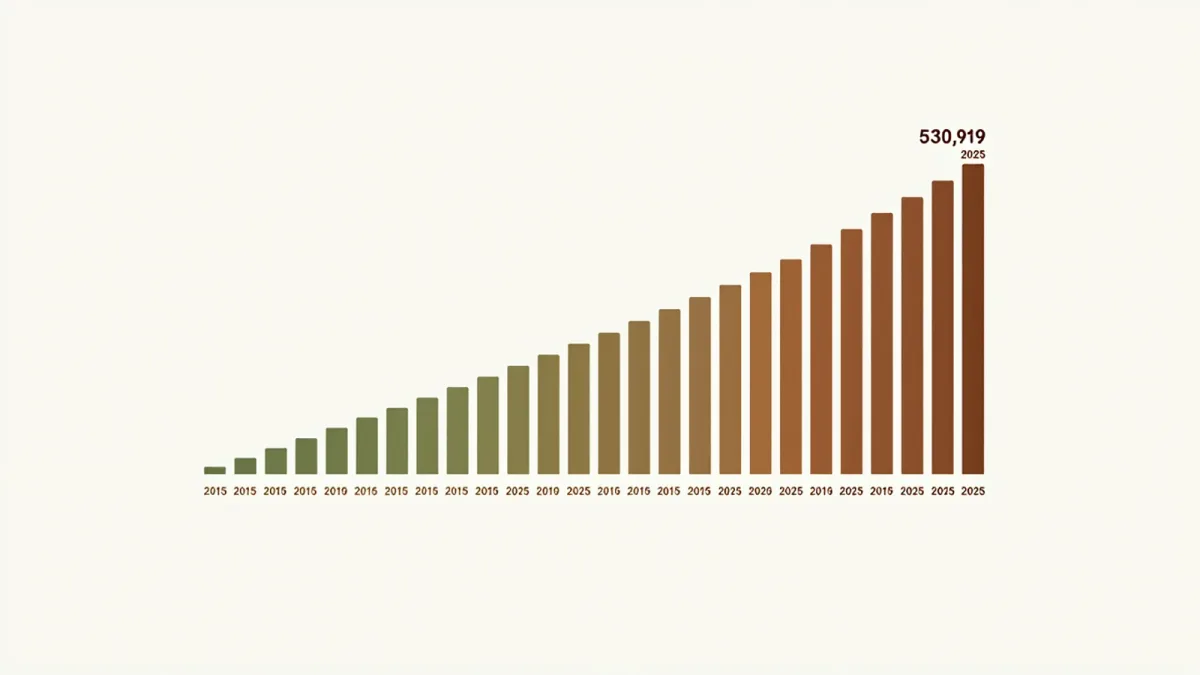
The Camino de Santiago has never been walked by so many. The Pilgrim's Reception Office in Santiago de Compostela issued 530,919 compostelas — the certificates granted to pilgrims who complete at least the final hundred kilometres on foot — in 2025, a record and a rise of roughly six percent over 2024, according to the office's annual statistics released after the close of the pilgrimage year.
The number is worth reading slowly. Ten years earlier the annual count was running near 280,000; the 2025 figure is close to ninety percent higher. A medieval penance that spent the twentieth century as a niche revival is now one of Europe's largest long-distance walking cultures, and the towns along the way — Sarria, Portomarín, Melide — organize their seasons around it. This site covers such developments for what they mean to the places themselves, not as booking advice, and the figures here come from the office's own published records.
Related stories: Pilgrims from 58 countries walked the Via Francigena in 2025 · Ten at-risk American places the World Monuments Fund calls irreplaceable.
Which routes carried the growth?
The Camino Francés remains the busiest route by a wide margin, but the fastest growth in recent years has come from the Portuguese Coastal Way, which hugs the Atlantic from Porto through Galicia. Analysts following the office's monthly tallies describe the pilgrimage's confirmed global dimension: pilgrims now arrive in large numbers from the Americas, Asia and Oceania, not only from Spain, Italy, Germany and Portugal.
What does the record mean for the route's towns?
Growth pays for albergues, bars and bakery shifts in villages that had been emptying for decades, but it also crowds the final week before Santiago in high summer. Municipalities in Galicia have responded with signage, sanitation and municipal albergue quotas, and the Galician government continues to promote the lesser-walked original routes. The office's 2025 tables, broken down by route, month and starting point, are the document to consult before choosing a quiet month.
Is the Camino still a pilgrimage?
The office does not ask why anyone walks; it asks only for a credencial stamped along the way. Roughly a third of recorded pilgrims in recent years have cited religious motives, with most of the rest citing religious-and-other or non-religious reasons — a split the numbers make visible every year.