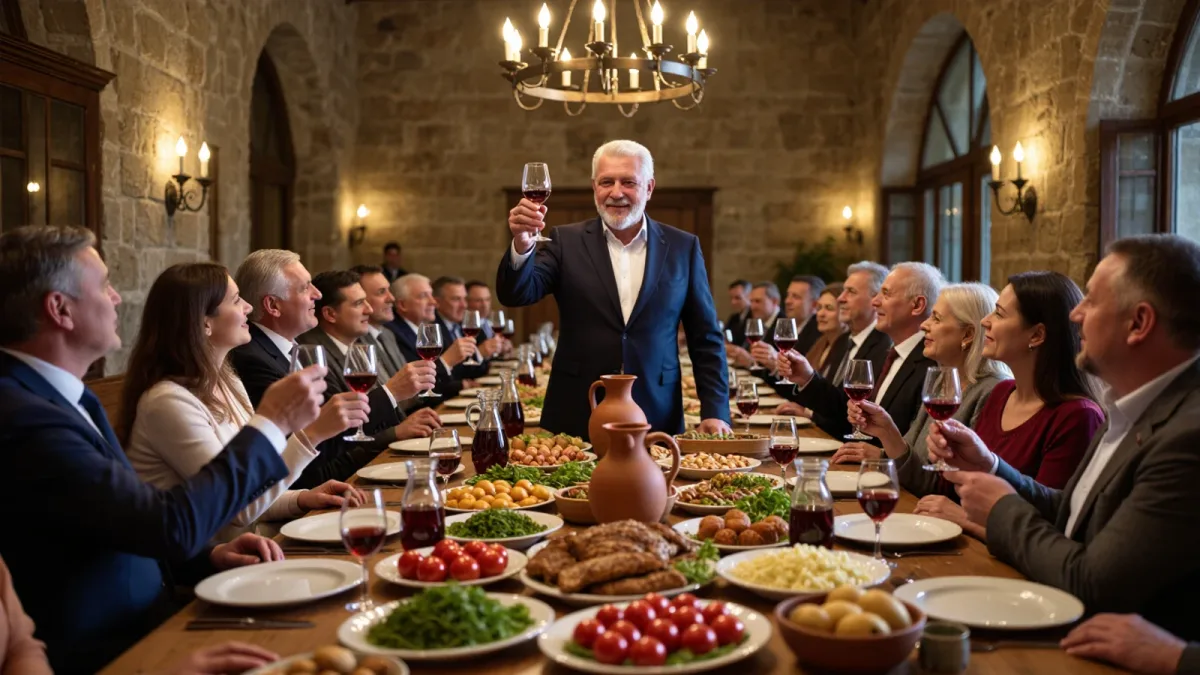
The supra is the Georgian feast, and it is run, not merely held. The word means tablecloth, the cloth that marks a table as set for guests, and under it the meal follows a protocol every Georgian knows: a tamada, the toastmaster, is appointed to lead, wine is poured for a sequence of toasts that must run in order, and the feast proceeds through speeches, songs, and courses for hours, with the tamada's authority quietly enforced by the whole table. Travelers who understand the structure are welcome at one; travelers who do not can sit through a masterpiece of hospitality without noticing the machinery that carries it.
What is a tamada and why does the feast need one?
A chair, an orator, and a regulator. The tamada is chosen by the host or proposed by the table, ideally a guest rather than the host, and must be a person of standing who can speak well, drink responsibly across a long evening, and read the room. Toasts at a supra are not interruptions of the meal; they are its skeleton. The tamada delivers them in a recognized order, to the occasion, to the family, to the departed, to the homeland, to friendship, each followed by silence or a response, and no one drinks between toasts. The discipline is the point: the sequence turns random drinking into a composition, and the tamada is its conductor.
The role has formal recognition in Georgian culture well beyond the dinner table, appearing in folk poetry and in the country's literature as the figure who speaks for the assembly. A good tamada's speeches run from a toast's nominal subject outward, through a story, a verse, an aphorism, and back, and the table judges the performance the way an audience judges a concert, with standards and no mercy for padding.
What does the table itself follow?
A set choreography of dishes and pacing. The supra opens cold: greens, herbs, nuts, the salads and pkhali pastes that buy time for the hot courses, then khachapuri and grilled meats arrive as the toasts lengthen, and the table paces itself across hours. Wine is central and traditional, poured from the pitcher the tamada controls into small glasses, and Georgian winemaking claims the world's oldest continuous lineage: qvevri, the buried clay vessels in which wine ferments and ages on skins, correspond to a winemaking tradition in the South Caucasus that archaeology dates back some eight thousand years, and the method remains in daily use across the country.
The guests have duties as well. The alaverdi, the response toast a guest offers back to the tamada, is a recognized move with its own etiquette, and a guest honored with one is expected to rise to the occasion. To the table's western edge sits the toadibari, the tamada's counterpart responsible toasting the ladies, in the traditional division of the work. None of this is written law; it is common knowledge every Georgian absorbs at family tables, which is why the machinery runs without printed rules.
Regional practice varies in ways worth knowing without being policed. At Imeretian tables the toast order runs brisk and the food arrives early; at Kakhetian supras, in the country's deepest wine country, the toasts stretch longer and the pitchers circulate from the marani, the family wine cellar, in quantity. Mountain tables keep their own heroes and their own songs, and a feast at a wedding, a funeral, and a homecoming each carry different obligations within the same grammar. The visitor's advantage is that the differences are directions of emphasis rather than rival rulebooks: wait for the tamada, honor the sequence, and the table will do the interpreting.
Related stories: Inside the diwaniya, Kuwait's evening gathering · The children who sing England's cathedrals every day.
How should a traveler behave at a supra?
Accept, arrive, and follow. An invitation to a supra is a serious gesture and should be answered warmly and honored if at all possible; arriving empty-handed is acceptable at family tables but a small gift never offends. At the table, wait for the toast before drinking, keep pace rather than compete, and if the tamada calls on you, a sincere short speech about friendship or the occasion is worth more than a polished performance. Saying a word for the hosts, for the table, or for your own country's table is the traveler's safest alaverdi.
Pacing advice is practical rather than prudish. A supra runs long, and the toasts arrive in roughly the same order regardless of region, so a guest who drinks fully at the early toasts will be unavailable for the late ones, which are the best. Georgians regard the refusal of wine with more tolerance than visitors expect, particularly when it is principled and stated with warmth, but the refusal of food puzzles them, so come hungry and let the table feed you.
Scholars of the Caucasus have long noted that the supra survived the century that tried to standardize everything else. Soviet years brought the feast into kitchens and dachas without breaking the toast order, and independence returned it to the restaurants and family courtyards where visitors now meet it. The continuity is the culture's own answer to what it considers essential: a country can change economies, flags, and alphabets, but the table, the cloth, and the person who speaks for the assembly stay. A traveler invited to sit down is being handed the working document, and one evening of paying attention reads it faster than any book.
Why does the supra matter to the culture?
Because it is the venue where the society does its real talking. Engagements are negotiated, friendships declared, grievances settled, and grief shared at supras; the feast is the country's parliament of personal life, and its rules are a social contract about how strangers become friends. The tamada's sequence gives even a large, mixed table a shared spine, so that a guest who speaks no Georgian still follows the evening's architecture, laughter and silence arriving on cue.
For the visitor, the supra is the clearest lesson Georgia offers about hospitality as structure rather than mood. The tablecloth is literal; under it lies an entire grammar of belonging, spoken in toasts, and a traveler who learns even its first phrases, the acceptance, the waiting, the speech that gives back, leaves the table knowing something no guidebook prints.